It Started With a Door Nobody Wanted to Deal With
In early 2024, the door to our main conference room started squeaking. Not a subtle squeak—the kind of grinding, high-pitched groan that makes everyone in a meeting glance up at the ceiling like the building's about to fall down.
I'm the office administrator for a 180-person manufacturing company. I handle procurement across three buildings—everything from paper towels to PPE to the occasional piece of equipment. Facility repairs aren't technically my job, but when something in the office breaks, it usually lands on my desk first. So the door became my problem.
I'd been putting it off for about a month. It's one of those things that's easy to ignore until it isn't. And honestly, I figured someone else would deal with it eventually.
Nobody did.
The "Quick Fix" That Turned Into a Real Problem
One of our maintenance guys sprayed some WD-40 on the hinges. That worked—for about a week. Then the squeak came back, and this time the screws holding the top hinge were visibly backing out. Maybe an eighth of an inch. You could see them sticking out.
I figured this was a five-minute job. I grabbed a flathead screwdriver from a random desk drawer and tried tightening the screws.
Turns out they were Phillips head. I wasn't paying close enough attention, and I stripped the top screw pretty badly. Not the screw's fault—mine, entirely.
I stood there looking at this chewed-up screw head, realizing I'd just turned a minor annoyance into a real repair. The hinge wasn't just squeaky anymore. The whole door was starting to sag because the top screw couldn't hold properly.
That was on a Thursday. By Friday morning, the door was dragging on the frame.
I called the property management company. They sent a contractor, who took one look at it, shook his head, and said he'd need to replace the hinge, re-hang the door, and reset the frame. The total came to $1,240—parts, labor, and new heavy-duty screws.
All because the screws didn't match the driver I grabbed. A 30-second error in tool selection cost us over a thousand dollars.
What I Did Next
After that experience, I did some research. I wanted a single, organized kit that lived in a central location—something anyone in the office could grab when they needed to tighten a screw, replace a hinge pin, or handle whatever small thing came up before it became a big thing.
I ended up putting together a small maintenance tool kit for the office. Here's what I found most useful:
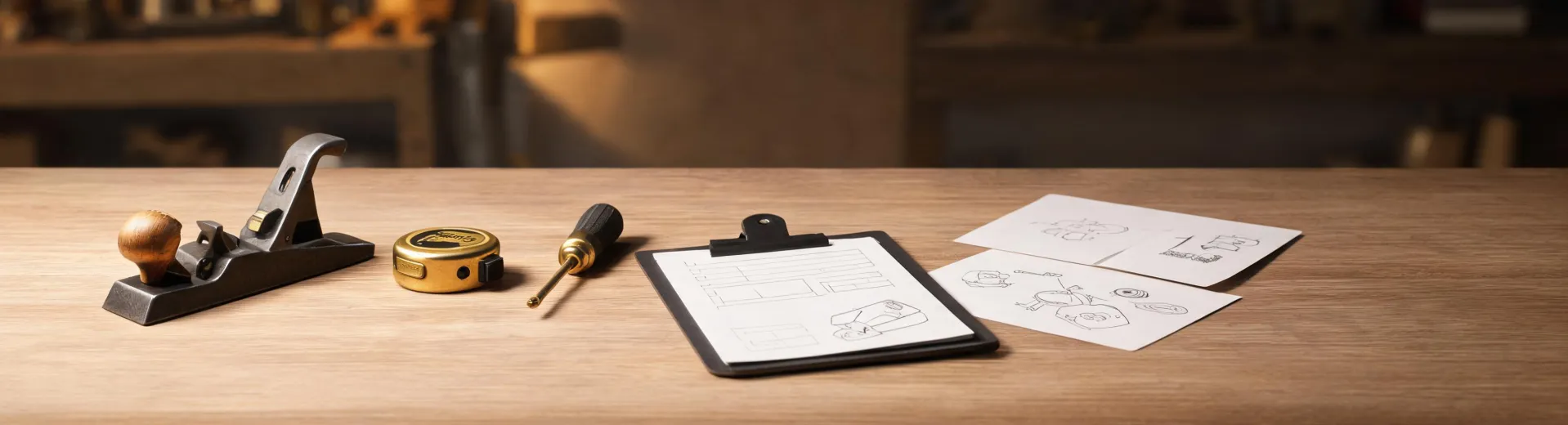
A bitholding screwdriver was the first thing I ordered. This is essentially a screwdriver that stores interchangeable bits in the handle—so instead of hunting for the right screwdriver all over the office, everything's in one tool. Phillips, flathead, Torx, square drive. I chose a Stanley model because it had consistent reviews at the price point—around $15-20. That one tool would have prevented my entire mistake.
I also grabbed a Stanley FATMAX toolbox to house everything. Decent latch system, enough compartments that it doesn't become a junk drawer situation. And a proper hammer for tapping hinge pins—because I found out our maintenance guy had been using the bottom of his boot. Support your local tradespeople, folks. They deserve better tools.
Total cost for the kit: under $100.
I want to be clear, though—I'm not touching the boiler or the bronze ball valves in the mechanical room. Those need someone certified. I know my limits. But door hardware, cabinet hinges, loose deadbolts? That's within scope.
What I Actually Learned
The main lesson isn't about tools. It's about the cost of waiting.
That door had been squeaking for maybe six weeks before it became a $1,240 problem. If someone had spent 15 minutes checking it when it first started, we could've fixed it with a few drops of oil and a properly seated screw. Ten minutes of prevention versus a three-week repair backlog and a contractor invoice.
I've carried this into how I handle other office maintenance now. We have a 20-point checklist that covers common things—door hardware, light fixtures, HVAC filters, plumbing under sinks—and someone walks through it once a month. Not because these things fail often, but because when they do fail, the fix is almost always more expensive than the check.
It's tempting to think of tool purchases like this as overhead. But the whole kit cost less than $100. The door repair cost $1,240. Do the math.
5 minutes of verification beats 5 days of correction.
I realize that sounds like something you'd see on a motivational poster. But I've now got the invoice to back it up.
A Few Honest Caveats
This worked for us, but our situation was pretty specific—three buildings, moderate foot traffic, and a maintenance team that handles the big stuff but doesn't always have the right small tools on hand.
If you're a large facility with a dedicated maintenance department, you've probably already solved this. If you're a small office where nobody's formally responsible for facility upkeep, the calculus might be different—but honestly, it's probably even more worth doing. Nobody wants to be the person who figured out the hard way that a $15 tool replaces a $1,200 repair.
And I'm not saying every squeaky door needs a full tool kit. Some squeaks really are just metal-on-metal friction that a little lubricant will fix. It's tempting to think the answer to "what to use for a squeaky door hinge" is just oil. But that advice ignores the difference between surface friction and loose hardware. If the hinges are wobbly or the screws are backing out? That's structural. That's when you want the right driver, the right bits, and about 10 minutes to spare.
Here's what I've stopped doing: assuming small problems will stay small.
The door's been quiet for over a year now. Every time I walk past it, I think about that stripped screw. And honestly? I'm kind of glad it happened. The kit we put together has saved us from at least three other small repairs since then—a loose cabinet hinge in the break room, a deadbolt that needed adjustment, and a rolling chair that just needed a caster replaced.
None of those things would have made anyone call a contractor. But each one would have sat unfixed for weeks if we hadn't had the tools on hand to deal with them.
If you're managing office procurement and you don't have a basic tool kit on-site, put one together this month. It doesn't need to be extensive. A good bitholding screwdriver, a small hammer, some assorted screws, and a storage box. That's the entire prevention cost.
The alternative is waiting. And waiting has a way of sending you an invoice.
Prices mentioned are based on my own purchases in 2024. Your costs will vary by vendor and region.

Omar Vukovic
Omar Vukovic is an independent garden and outdoor power equipment analyst covering pruning shears, loppers, hedge shears, lawn mowers, tillers, chainsaws, and related cutting systems. He applies IEC 62841-4 safety principles while comparing blade geometry, chain speed, bar length, cutting capacity, battery runtime, vibration, kickback controls, noise, ergonomics, and maintenance access. His practical articles help landscape teams and buyers choose equipment for vegetation, workload, operator control, serviceability, and seasonal operating conditions.